
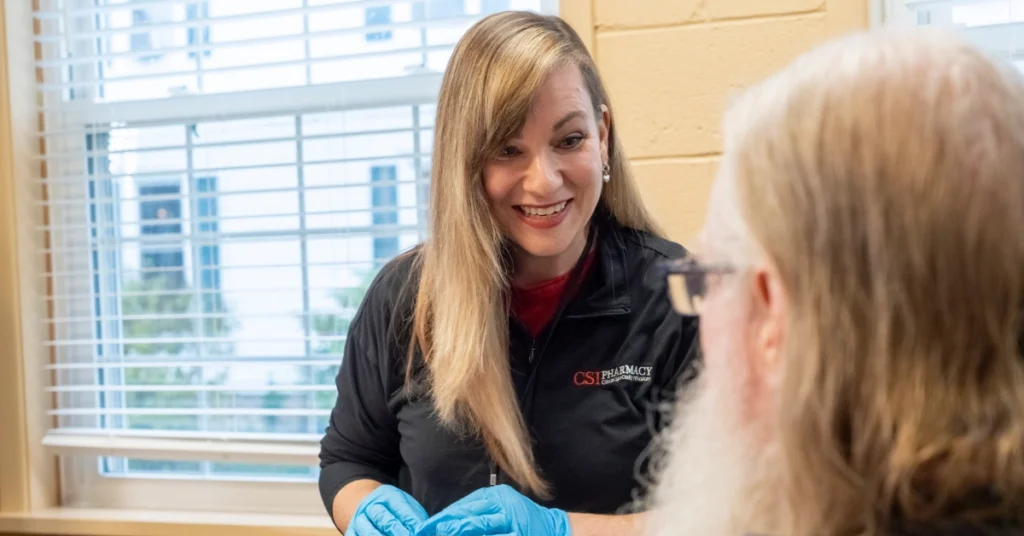
Home infusion nursing is one of the most autonomous and personally rewarding specialties in the field of nursing, but what people don’t know is that it’s more than just administering immunoglobulin (Ig) therapy for patients with rare and chronic conditions. A home infusion nurse gets to know their patients in order to see the whole picture, not only assessing vital signs, but the patient’s environment, emotional state, and whatever else they might need to feel safe and comfortable during their Ig therapy treatment.
We asked two of our home infusion nurses, Gretchen and Juliannette, to walk us through what a day in the life of a home infusion nurse actually looks like with CSI Pharmacy.
In This Article:
- How Do Home Infusion Nurses Prepare for Patient Visits?
- What Skills Does a Home Infusion Nurse Need?
- What Does a Home Infusion Nurse Do When They Arrive at a Patient’s Home?
- What Does a Home Infusion Nurse Monitor During an Ig Therapy Visit?
- How Do Home Infusion Nurses Handle Unexpected Situations in the Field?
- Why Do Nurses Choose a Career in Home Infusion Nursing?
- Frequently Asked Questions About Home Infusion Nursing at CSI Pharmacy
- Starting Your Home Infusion Nursing Career with CSI Pharmacy
How Do Home Infusion Nurses Prepare for Patient Visits?
Home infusions nurses begin preparing for patient visits before they ever leave the house by reviewing patient notes, organizing supplies, and mapping out a route that accounts for drive times. That level of preparation is what makes it possible to deliver consistent, safe patient care across multiple homes in a single day.
What Does a Home Infusion Nurse Pack Before a Shift?
A home infusion nurse packs patient notes, medical supplies, and enough personal essentials to sustain them for back-to-back patient visits. For Gretchen, a home infusion nurse with CSI Pharmacy, she knows that what she packs, how she organizes her route, and her communication with patients will set the tone for the entire day.

“My typical day after packing up lots of drinks and snacks, water is key, I make sure that I have my notebook with all of my weekly patients’ information, as well as plenty of pens. I clock in via my phone before leaving my home and then I put my patient’s address in my GPS. Most of my drives range from 1.5-3.5 hours one way so when I make a pit stop, I typically call or text my patient to let them know I am about 30 minutes out so they can take their premeds and be ready for my arrival.” – Gretchen, Home Infusion RN
What Skills Does a Home Infusion Nurse Need?
Home infusion nurses must be able to manage patient care, treatment documentation, family education, and real-time clinical decisions all at the same time. Juliannette describes what that actually looks like in practice.
“People are usually surprised by how much of my day is spent multitasking and anticipating needs before they happen. It’s not just patient care – it’s constant communication, documentation, educating families, and making quick decisions while still trying to make every patient feel seen and cared for.” – Juliannette, Home Infusion RN

The clinical side of in-home Ig therapy is only one piece of the puzzle. The rest is communication, coordination, and the kind of thoughtful preparation that puts patients at ease before the nurse even arrives.
What Does a Home Infusion Nurse Do When They Arrive at a Patient’s Home?
When a home infusion nurse arrives at a patient’s home, their first priority is getting to know their patients by seeing how they’re feeling and what they need to feel comfortable during their visit. When Gretchen arrives at a patient’s home, she doesn’t immediately shift into clinical mode. She starts by getting to know who the person is and how best she can care for them.
“I always like to ask my patients a few questions before getting started, such as if that person has any pain and if they have had any falls since their previous visit… Every person is special, and everyone’s needs are different.” – Gretchen, Home Infusion RN
These questions serve a dual purpose: they help establish a clinical baseline while building trust through consistent, personal check-ins that give nurses a clearer picture of their patients’ overall health and well-being.
How Do Home Infusion Nurses Adapt to Each Patient?
Skilled home infusion nurses adjust their clinical approach based on each patient’s individual comfort level and preferences. Gretchen explains how she reads a patient’s needs from the moment she arrives.
“Sometimes I take a patient’s vitals upon arrival before starting their IV, but if someone has a log of anxiety about a needle, I may get their IV started first and just have a relaxing conversation with the patient before getting those vitals going. Some patients like to sleep, others love to watch TV, and some just want to visit. You will get a feel for a patient’s needs pretty quickly.” – Gretchen, Home Infusion, RN
This flexibility is one of the most meaningful advantages of home infusion care. Patients see the same nurse for their treatment over time, building a connection that makes every visit feel less like a medical procedure and more like a check-in with someone who genuinely cares. At the same time, our infusion nurses find it extremely rewarding to be able to see the direct impact their care makes.
What Does a Home Infusion Nurse Monitor During an In-Home Ig Therapy Visit?
Home infusion nurses monitor a comprehensive range of clinical and environmental factors throughout every visit, going beyond what a standard clinic appointment might assess. While the patient is resting comfortably, the home infusion nurse is actively observing, documenting, and making real-time clinical judgments the entire time.
“During a visit, I’m monitoring much more than vital signs. I’m paying attention to changes in condition, pain levels, breathing patterns, mobility, mental status, medication effectiveness, safety concerns, emotional well-being, and even subtle behavioral changes that could signal something bigger. A lot of nursing is noticing the things that aren’t immediately obvious.” – Juliannette, Home Infusion RN
Do Home Infusion Nurses Assess the Patient’s Home Environment?
Yes home infusion nurses always assess the patient’s home environment upon arrival, and assessing the home environment is one of the most clinically significant advantages of in-home care over a clinic setting. Juliannette explains what she looks for beyond the patient’s physical condition.
“I also look for social determinants of health. How clean their environment is, financial struggles or concerns, family and support dynamics play a large part in healing and maintaining good health.” – Juliannette, Home Infusion RN
A patient might say they’re fine, but a skilled home infusion nurse is watching for how they move, listening to how they’re breathing, and picking up on any non-verbal cues. These observations inform everything from patient education to recommendations for additional support, making in-home Ig therapy a comprehensive care experience.
How Do Home Infusion Nurses Handle Unexpected Situations in the Field?
Home infusion nurses are trained to make independent clinical decisions in real time, often far from a clinic or hospital, but at CSI Pharmacy, they don’t do it alone. At CSI Pharmacy, our infusion nurses receive specialized immunoglobulin therapy training through the Immunoglobulin National Society (IgNS). This credential empowers our infusion nurses to confidently make decisions and improve patient outcomes.
What Support Does CSI Pharmacy Provide to Home Infusion Nurses?
CSI Pharmacy provides home infusion nurses with dedicated supervisors, collaborative team members, and clinical technology tools built for independent field work. Gretchen describes what that support looks like on a typical day.
“Our nursing supervisor in the state of Arkansas is superb! We also have two amazing team leads who jump in to help when questions need answers. In a serious case of a reaction, I would call the supervisor, but in most cases, I can contact the team and get an answer pretty quickly.” – Gretchen, Home Infusion RN
The combination of experienced supervisors, responsive team members, and supportive tools means nurses have what they need to act quickly and confidently when something unexpected comes up.
What Technology Do CSI Pharmacy Infusion Nurses Use in the Field?
CSI Pharmacy equips home infusion nurses with digital tools and education that put patient information and medication resources at their fingertips during every visit. Gretchen explains how those tools directly enhance the care she delivers.
“I love the OneDrive that we use for information for medications as well as the Health Overview that has been added to our records. The Health Overview gives a synopsis for the patient you are currently seeing and it’s amazing. Our nursing education team is top notch in giving us the extra resources that makes CSI Pharmacy #1” – Gretchen, Home Infusion RN
When a home infusion nurse has the right support and technology behind them, they can spend less time searching for information and more time focusing on care, making faster, more confident decisions with every visit.
Why Do Nurses Choose a Career in Home Infusion Nursing?
Nurses choose a career in home infusion nursing because of the genuine connection they are able to make with their patients. After hours on the road and managing complex medical situations, we asked Gretchen and Juliannette what keeps them coming back. The answer wasn’t the autonomy, the variety, or even the flexibility in the role. It was something more personal.
“The most meaningful part of my job is getting to know my patients beyond their diagnosis. Every patient has a story, a life experience, and lessons they’ve gained along the way, and I genuinely value being able to hear and learn from them. Building those connections and being trusted during vulnerable moments is incredibly meaningful to me, and it’s one of the things that makes nursing so rewarding.” -Juliannette, Home Infusion RN
Home infusion is different from nearly every other nursing setting, as they see their patients for months, sometimes years. They become a familiar presence in someone’s routine, learning their stories and what matters to them beyond their diagnosis.
That continuity of care is what sustains a career in this field. Being trusted with someone’s care and seeing the direct impact of that care is something our nurses genuinely look forward to with every visit.
Frequently Asked Questions About Home Infusion Nursing at CSI Pharmacy
How Do I Become a Home Infusion Nurse?
Home infusion nurses are typically registered nurses with at least one to two years of clinical experience. Prior Ig therapy or infusion experience is preferred. At CSI Pharmacy, all of our home infusion nurses are credentialed by the Immunoglobulin National Society (IgNS). Each nurse is trained in safe preparation, administration, and monitoring of immunoglobulin treatments.
Does CSI Pharmacy Have Nursing Positions Available in My State?
CSI Pharmacy offers home infusion nursing positions in all 50 states. Because nurses work in patients’ homes rather than at a physical infusion center or clinic, opportunities are available in both large metro areas and smaller communities across the country. Visit the CSI Pharmacy careers page to see currently open nursing roles near you.
What Does a Typical Home Infusion Nurse Schedule Look Like?
Home infusion nurses at CSI Pharmacy typically visit 3-5 patients during the day, allocating time for driving between patient visits and spending time administering Ig therapy and care during the patient’s treatment.
What Makes CSI Pharmacy Different as an Employer for Home Infusion Nurses?
CSI Pharmacy is committed to the professional growth and clinical excellence of every nurse on the team. Beyond dedicated nursing supervisors and collaborative team members, our infusion nurses are members of the IgNS, giving them access to the latest Ig education, research, and clinical resources in the specialty.
CSI Pharmacy also has a dedicated nursing education team and clinical research team, focused on continuous learning while working to advance patient outcomes and quality of life.
Do Home Infusion Nurses See the Same Patients Regularly?
Yes – CSI Pharmacy prioritizes continuity of care, meaning nurses typically care for the same patients. This allows nurses to build meaningful, long-term relationships with the people they care for.
What Diseases Do CSI Pharmacy Treat?
CSI Pharmacy provides home infusion Ig therapy for a wide range of rare and chronic conditions including CIDP, primary immune deficiency diseases, multiple sclerosis, myasthenia gravis, Guillain-Barré syndrome, stiff-person syndrome, myositis, PANS and PANDAS, and many others. See the full list of diseases we treat.
Start Your Home Infusion Nursing Career with CSI Pharmacy
At CSI Pharmacy, home infusion nursing combines clinical expertise with a genuine human connection between the nurse and patient. It’s a role that demands independence, critical thinking, and a deep compassion for the work.
If you’re a registered nurse looking for a career that lets you practice while building connections with your patients, explore CSI Pharmacy’s open home infusion nursing positions.
About the Authors:
Juliannette Davis, MBA-HA, BSN, RN is a home infusion nurse at CSI Pharmacy with a background that spans both clinical nursing and healthcare administration. Her dual perspective, grounded in direct patient care, shapes the thoughtful, whole-person approach she brings to every visit.
Gretchen Newberry, BSN, RN is a home infusion nurse at CSI Pharmacy who has built her practice around preparation, consistency, and the kind of personal connection that only comes from seeing the same patients week after week. Her meticulous approach to every shift reflects the standard of care that CSI Pharmacy values in our home infusion nurses.